
23rd July 2026
MULTI-STAGE LASER PROCESSING
Multi-Stage Laser Processing
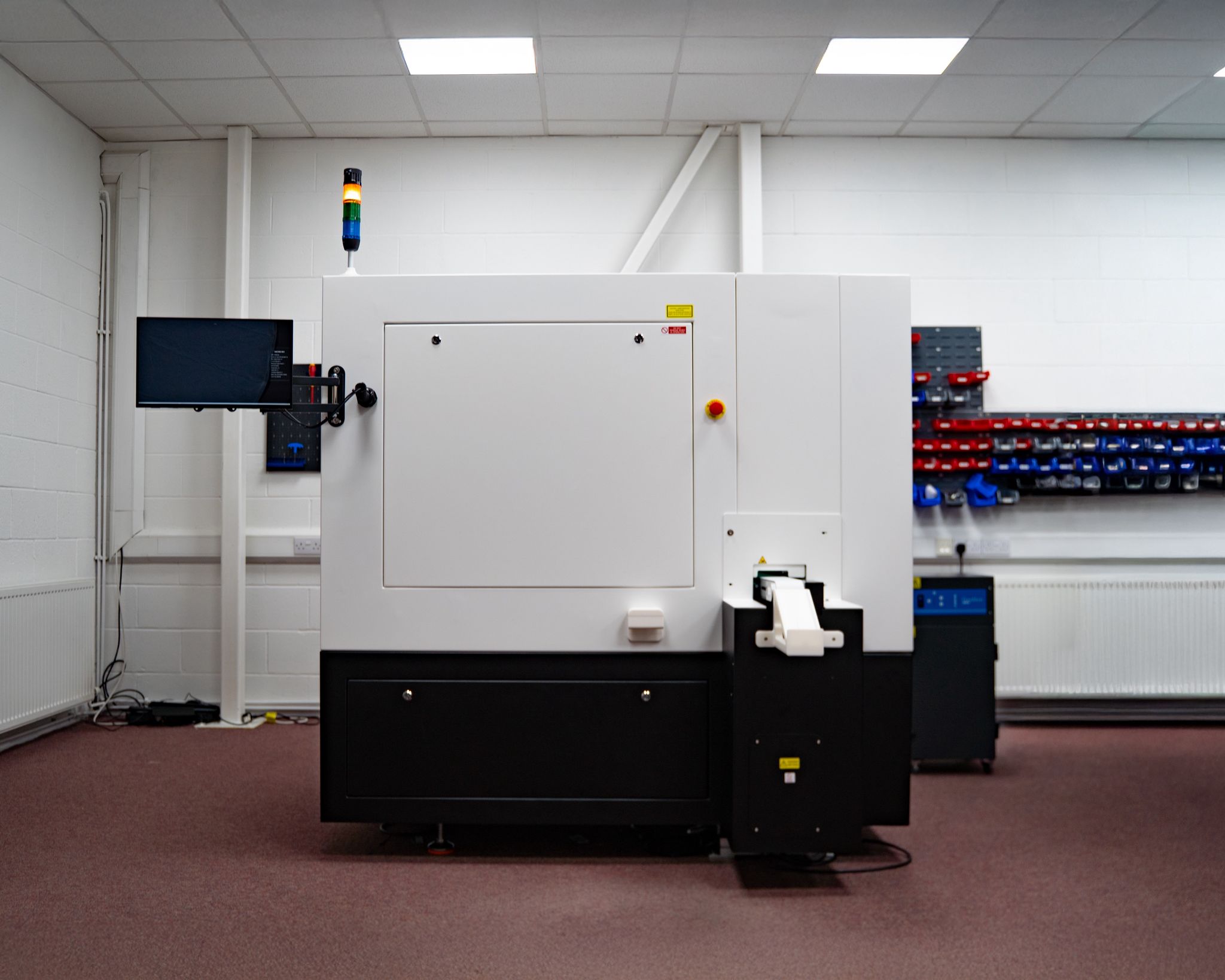
A recent custom project delivered by the Watt Laser team involved the development of a multi-stage laser processing solution capable of handling and processing small individual parts through a single automated workflow.
Kristen Rivett, Fraser Hemming
Business Development Executive, Senior Product Engineer
Our customer approached us looking for a solution that required laser processing, part labelling and post-process inspection. The solution needed to support an initial low-volume (100-part batch), with a clear route to scale up to high-volume production (1 million parts per annuum on a 5×8 shift pattern).
The project had a number of key requirements:
- Ensure compatibility with specific and sensitive green light manufacturing conditions.
- Simplify process part loading and unloading.
- Automate the laser processing sequence as much as possible.
- Minimise the system footprint to fit the current production process.
Their requirements initially suggested a manual load and unload through a two-drawer shuttle system.
That initial concept formed the beginning of the scoping phase, one of the most valuable parts of a custom project. As we worked closely with the customer and learnt more about the application, we began to understand not just what our customer needs but why they needed it. This phase is critical for us as a supplier to uncover any existing challenges with previous equipment or processes, what’s important to them and where we can add value. This allows us to challenge the concept from all engineering angles and refine it as much as possible.
The final solution combined multiple process stages into a compact, single-flow and automated platform, incorporating:
- A continuous conveyorised internal process, effectively creating a mini production line in a box.
- High-magnification vision systems coupled with Watt Laser’s bespoke AOI algorithm for alignment and post-process inspection.
- Laser marking of parts for digital identification and traceability.
- Laser processing of a dedicated reference feature on every part, creating a repeatable datum for downstream calibration and quality verification.
- Automated control of defective parts into a dedicated reject drawer. These parts were permanently laser marked to ensure they cannot re-enter production.
- Automated control of incorrectly loaded parts into a dedicated reload station for retrieval and reprocessing, preventing downstream errors and potential scrap.
- Fully automated sequencing between each process stage, creating one seamless manufacturing workflow.
- Dual user interface comprising of a single operator touchscreen and a secondary display. Both interfaces are driven by a Watt Laser bespoke software application, providing live camera views, real-time job and part data, process monitoring and production yield information.
The final solution became a much more capable and automated manufacturing platform than originally anticipated, while still meeting everything the customer initially set out to achieve.
For us, this project was a prime example of why we put so much value on the scoping phase. The more we understood about the application and what the customer was trying to achieve, the more opportunities we saw to improve on the original concept. The customer trusted us to bring our own ideas and experience to the table, giving us the freedom to challenge and refine along the way.
That’s how we like to approach custom projects at Watt Laser. Our customers know their application better than anyone, and we bring the engineering and laser processing expertise to help turn that knowledge into the right solution. By bringing the two together, you can uncover ideas and opportunities that neither side may have considered at the start, which is often where the best solutions come from.


Case Studies
NEXT-GENERATION SMT LASER CUTTING
Why first-generation systems have reached their limits, and what NEVIS changes.
Show Next Case Study