
24th July 2026
REDEFINING THE STANDARD
Kristen Rivett
Business Development Executive
Ask anyone in SMT assembly what changed their world, and they will likely point to the early 2000s. It was an exciting time to be in our industry. The introduction and wider adoption of fibre-based laser sources sparked a massive wave of innovation and capability.
At the same time, laser-cut stencils were becoming the backbone of modern SMT assembly, helping to create what is now a billion-dollar industry. Laser cutting rapidly established itself as the dominant manufacturing technology, driving demand for a new generation of dedicated stencil production systems; one that would go on to define the market for many years.
Watt Laser entered this market in 2021 with the SC12 platform. The SC12 put us on the global map, but more importantly, it gave our engineering team a vital, hands-on masterclass. It provided a critical baseline for understanding both the strengths and limitations of the technologies that had come to define stencil laser cutting.
But as everyone knows, electronics manufacturing has never stood still.
Over the last two decades, manufacturing requirements have continued evolving. Feature sizes have shrunk to microscopic scales, aperture densities have skyrocketed and expectations surrounding repeatability, accuracy and process controls have continued to rise. At the same time, much of the industry is operating with machine architectures and process philosophies originally developed around manufacturing capabilities from a very different era of electronics production.
A few years ago, we decided to explore this shift and confront the next generation emerging on the horizon. This led us to develop MLAb (Monolithic Laser Ablation), which focuses on the industrialisation of ultra-fast, ultra-short-pulsed laser source technology.
The truth is the capability we are pioneering through MLAb is way ahead of where much of the market is ready to go. While the potential is clear and the technology is proven, the leap remains too big to make for many. Manufacturers are inherently hesitant and resistant to change. But what we have been uncovering is far too valuable to leave until the market is ready. The further we progress with MLAb, the more we start questioning and challenging assumptions that have been long held across conventional laser processing. It made us realise that there is a significant gap between where laser processing sits today and where MLAb takes it. It was this middle ground that was our opportunity.
The fusion laser cutting systems that came to dominate the SMT market were hugely successful and established manufacturing methods we all still rely on today. But success has a habit of creating comfort. Over time, certain limitations and processing compromises had slowly become accepted. Certain workarounds and ways of doing simply became ‘how things are done’. As a relatively new entrant to the market, this worked to Watt Laser’s advantage. We lacked the baggage of legacy thinking. We looked at these challenges with fresh eyes and we started asking the uncomfortable questions that weren’t being asked.
Through this, we discovered a massive gap between where electronics manufacturing was heading and where stencil manufacturing had plateaued. This realisation became the definitive blueprint for our next major leap: NEVIS.
The question for our team was no longer whether ultra-advanced laser processing was possible; through MLAb we had already proven that. The far more compelling question was how much of that advanced thinking could be applied directly to conventional fusion laser cutting. It quickly became clear to our engineering team that ultimate manufacturing performance is rarely determined by a single technology in isolation, but instead the interaction and synergy between the comprising subsystems. Recognising this as our key lever, we decided to approach this challenge through the lens of a proven engineering philosophy, the concept of marginal gains.
We began with the motion system. Shifting away from the traditional gantry configuration, we upgraded to a split-axis mechanical design. By driving the workpiece along the Y-axis and moving the laser independently along the X-axis, we isolated the moving masses. This gained us smoother motion and transitions alongside higher speeds and acceleration.
Achieving this new level of motion control naturally forced a new question: how could we best optimise the laser beam? We modified the focusing optics within the laser head to achieve a smaller, more precise beam diameter. This gained us higher energy density which meant we were able to reduce the laser power, highlighting a massive industry misconception that more power is better.
Once we perfected the beam, we turned our attention to laser energy delivery. Through recipe tuning and optimisation, we developed our motion system to manage laser energy dynamically, a process we call Energy Position Optimisation (EPO). By synchronising motion control and laser output in real-time, the laser places energy exactly where and when it’s needed. This provides dynamic scaling and adaptation to real-time motion conditions, including velocity changes, acceleration, deceleration and varying feature sizes or geometries. This allows us to cut cleanly with no worry of distortion, burning or edge degradation.
To complement our motion improvements, we next focused on gas flow and turbulence control. We optimised the cutting head design to create a larger reservoir within the cutting head, ensuring a more consistent gas supply during processing. A dual-entry gas inlet further increased flow capacity and improved pressure stability, allowing for a more controlled cutting environment.
Next, the nozzle underwent an iterative design process, drawing on both lessons learned across the industry and incorporating features such as curved and chamfered edges for smooth movement across the workpiece. Our goal was to maximise the Bernoulli effect, helping to maintain the workpiece at the optimal laser focal plane throughout the cutting process. This was then tested and adjusted iteratively for the best overall performance.
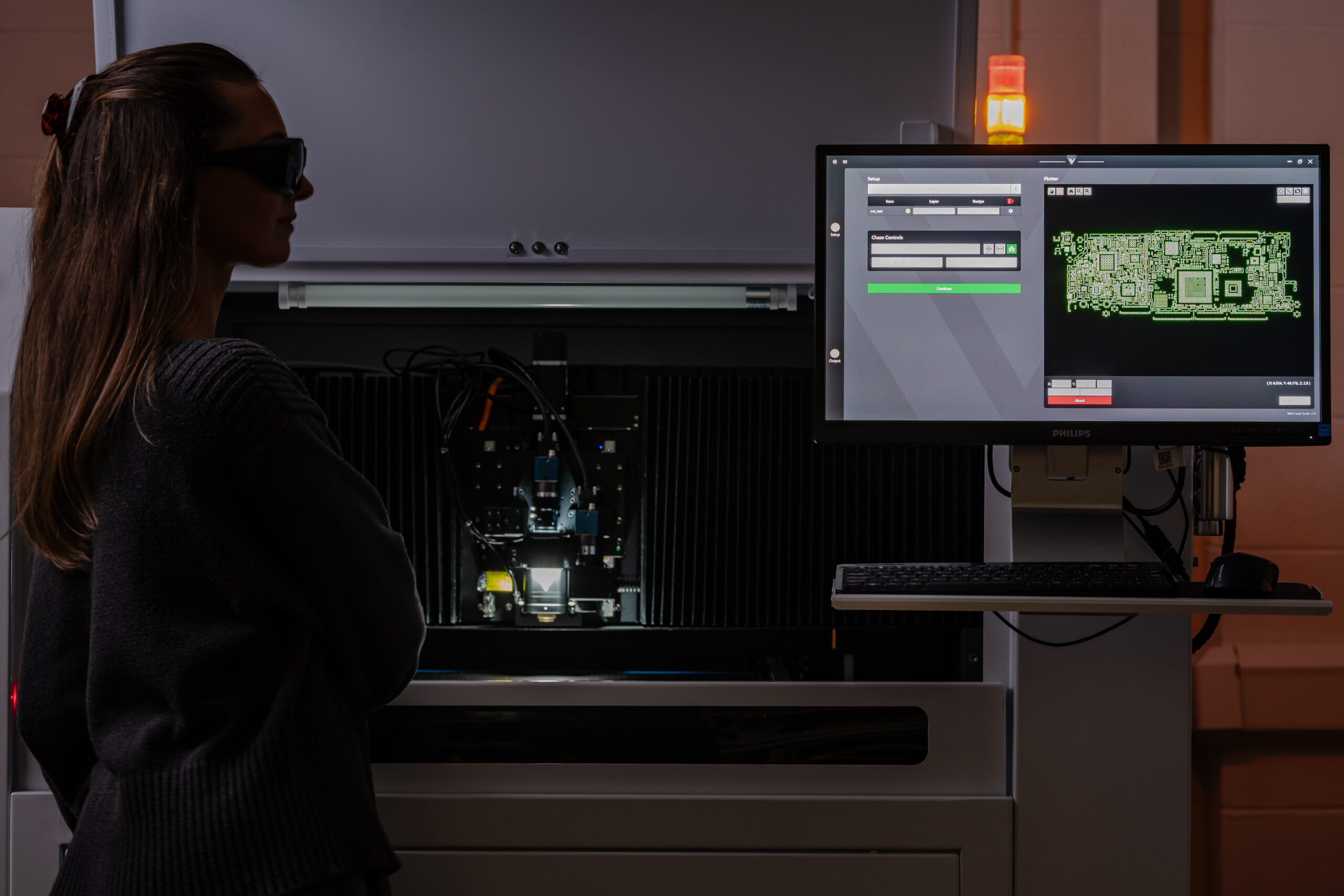
Of course, mechanical performance is only one part of the equation. Even the most advanced hardware cannot achieve consistent results if the process depends too heavily on manual setup and operator judgement. Small differences in setup, parameter selection and day-to-day operation can all introduce variation. To make the optimised laser cutting process truly repeatable and reproducible, we needed to remove as much opportunity for variation as possible. This is why we anchored NEVIS to the Watt Laser Software Suite. Designed with a simple ‘follow the green button’ philosophy, our software guides operators through setup, daily operation and maintenance in a logical sequence, removing as much need for human intervention and guesswork as possible. Operators don’t need to think about the next step, it’s right in front of them. This made it the perfect final piece of the NEVIS lineup.
Under the strategy of marginal gains, our ultimate advantage was bringing fresh, young minds together to challenge legacy thinking. The industry achieved great things with the technology available at the time. But now, it is time for a new generation to make the most of what is possible with the technology available today. NEVIS sets a new industry benchmark for SMT fusion laser cutting. From this point forward, the standard has changed, and the rest of the industry must keep pace.
Case Studies
LASER-BOND
Replacing wet chemical processing with laser technology.
Show Next Case Study